
Jurassic dinosaur egg nest discovered at Santa Cruz Beach, Torres Vedras
A small nest containing around 10 Upper Jurassic dinosaur eggs (approximately 150 million years old) has been discovered in the cliffs of Santa Cruz Beach, Torres Vedras. The find was made by researchers from Ci2Paleo of the Torres Vedras Natural History Society during paleontological survey work.
The eggs, preserved in three dimensions and arranged in a natural pattern, do not result from water transport, suggesting an original nesting site, possibly on a riverbank. Preliminary observations indicate that most of the hatchlings likely emerged successfully, although traces of embryos may still be preserved inside.
Based on the characteristics of the eggshells, researchers suggest the nest may belong to a carnivorous dinosaur. The fossil block will be studied using computed tomography and microscopic analysis of the shells. Portugal stands out as one of the few places in the world where Upper Jurassic dinosaur nests and eggs are found!

Image 1: Detail of fossilized eggshells, preserved three-dimensionally within the sediment, with identified fragments under study.

Image 2: Preliminary analysis of the block containing Upper Jurassic dinosaur eggs, using laboratory lighting and digital magnification.
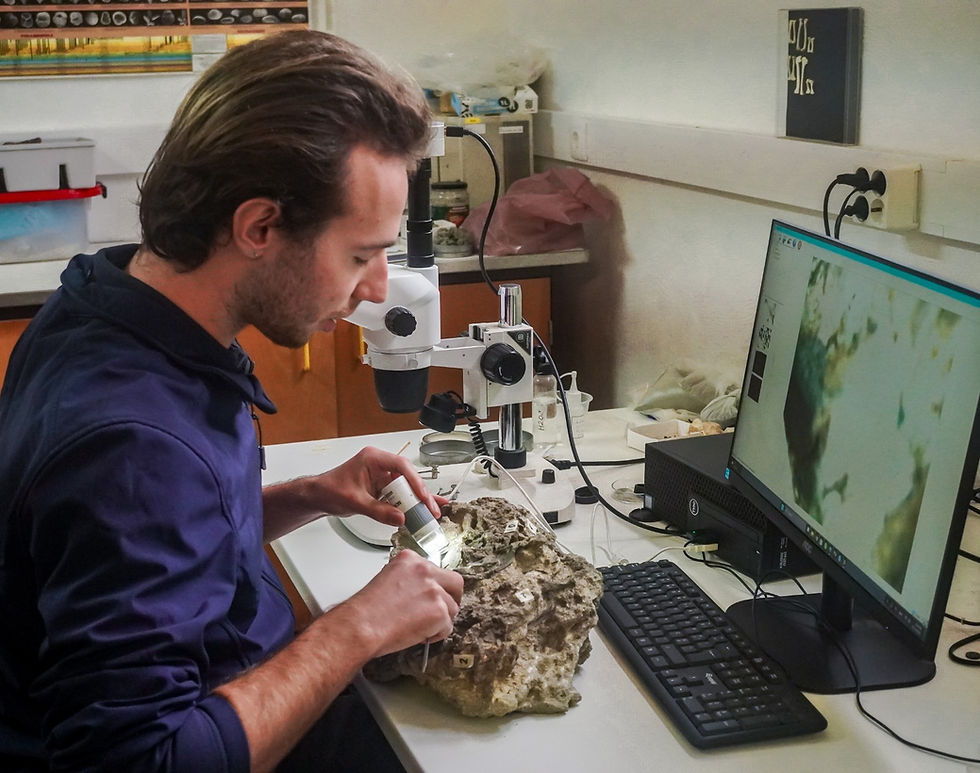
Image credit: Verena Fuchs / SHN


I find building useful digital learning habits easier to think about when there is a concrete question to start from. A digital workspace becomes easier to use when the next task is visible and distractions are limited. That is the kind of detail I would keep in mind while exploring digital learning habits. I would be interested in a simple example, because it is often the ordinary details that make an idea memorable. How do you decide which tools belong in a learning routine?
Considering developing reasoning through language and discussion, I keep coming back to the difference between knowing about an idea and putting it into practice. Explaining why an answer makes sense can reveal more than giving the answer itself. Seen this way, language and reasoning education becomes a topic to explore rather than something to sum up too quickly. A short discussion of an everyday example would make this easier for me to connect with, especially as someone still learning about the subject. Which discussion activities encourage learners to examine their own reasoning?
The topic of exploring wildlife through educational adventures gives me a few things to think about, especially when the discussion moves beyond general advice. Looking closely at an animal's habitat can be more informative than memorising its name alone. It gives me a more concrete starting point for thinking about wildlife learning activities. I am still thinking through the details, and a small example would help me picture how this works in practice. How could a wildlife activity encourage observation without disturbing the animals?
Thinking about helping children take ownership of learning, I find the smaller practical questions more interesting than a quick conclusion. Making a small choice can help pupils feel responsible for the way they approach a task. I would use that point as a starting question when considering student learning ownership. I can imagine different answers depending on the situation, so I would want to understand the context before drawing conclusions. Which decisions can children make meaningfully within a structured lesson?
What draws my attention to creating supportive school learning environments is the possibility of making an unfamiliar subject feel closer to everyday life. Clear expectations can make it easier for pupils to understand what a task is asking of them. I would use that point as a starting question when considering supportive school education. I can imagine different answers depending on the situation, so I would want to understand the context before drawing conclusions. How can classroom expectations remain understandable without becoming a long list of rules?