
Welcome, Cariocecus bocagei: a new dinosaur from the Early Cretaceous of Portugal!
An international team led by Filippo Bertozzo (Center for Paleobiology and Paleoecology – Ci2Paleo, Natural History Society of Torres Vedras, and Royal Museum of Natural Sciences of Brussels) has described a new species of ornithopod dinosaur, Cariocecus bocagei . The study was published today, September 15, 2025, in the Journal of Systematic Palaeontology.
A discovery in Sesimbra that is 125 million years old
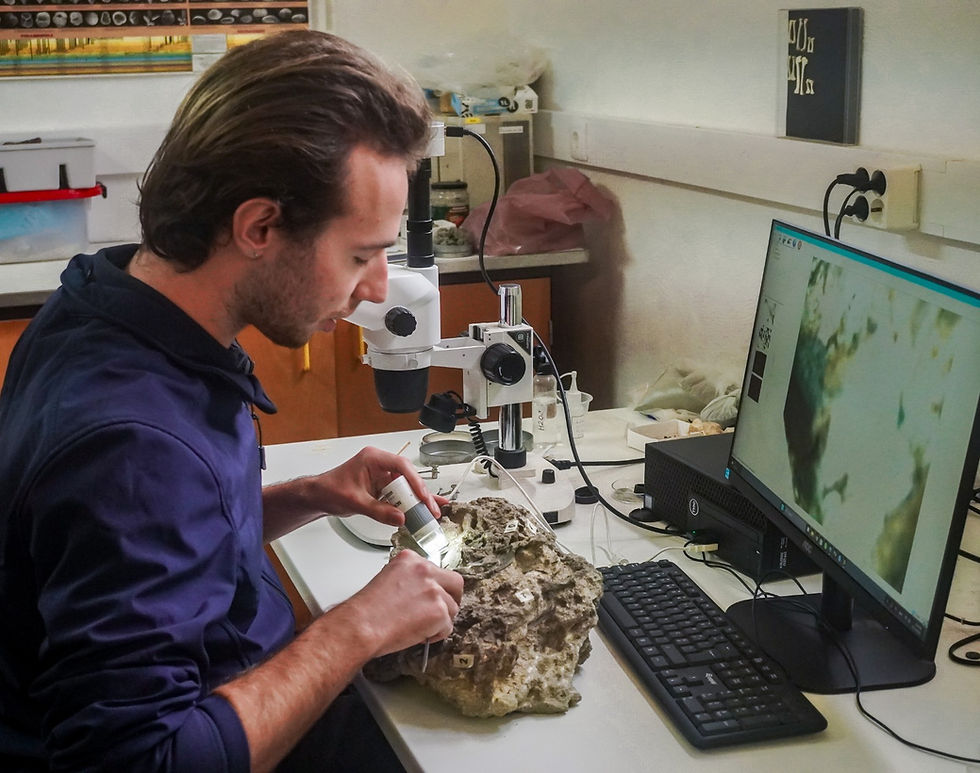
The fossil (SHN.832) was found in 2016 on Praia da Área do Mastro (Sesimbra), in deposits approximately 125 million years old. It was identified thanks to the keen eye of Pedro Marrecas, one of the study's co-authors. The specimen had a row of teeth visible in the rock, but only after careful preparation could they be revealed in detail.
The name Cariocecus evokes an ancient warrior deity venerated in the region before the Roman occupation, while bocagei honors the Portuguese naturalist José Vicente Barbosa du Bocage (19th century).

The most complete iguanodon from the Portuguese Cretaceous
According to Bruno Camilo (Ci2Paleo/SHN and Instituto Superior Técnico), this is the most complete dinosaur skull ever found in Portugal. It's a juvenile or subadult individual, which allowed us to study how the cranial bones fused during growth—information rarely preserved in dinosaurs.
Filippo Bertozzo highlights that this find “marks the discovery of the first Early Cretaceous iguanodont in Portugal, revealing the country's role as an evolutionary bridge between the Upper Jurassic dinosaurs and the more derived Cretaceous iguanodonts.”
Until now, only more primitive species had been identified in the Portuguese Upper Jurassic, such as Draconyx loureiroi, Eousdryosaurus nanohallucis and Hesperonyx martinhotomasorum.

A window into the dinosaur brain
The exceptional three-dimensional preservation of the skull allowed digital reconstruction of the cerebral endocast, cranial nerves and inner ear of Cariocecus .
"We're opening a veritable Pandora's box of dinosaur biology," says Ricardo Araújo (CERENA/IST and Ci2Paleo-SHN). The study revealed unique details about hearing and cranial development, as well as suggesting new clues for understanding these animals' metabolism and sensory capabilities.
The fossil also presents a unique characteristic among dinosaurs: the fusion of the jugal bone and the maxilla, possibly an adaptation to reinforce chewing.
A key piece in the evolution of hadrosauroids
Cariocecus bocagei is one of the oldest known hadrosauroids, suggesting that the group may have had a Euro-African origin, rather than an Asian one as previously thought.
“This mix of primitive and advanced features shows the complexity of iguanodont evolution in the Cretaceous,” explains Donald Cerio (Johns Hopkins University).
The investigation also had the collaboration of Victor Carvalho (Ci2Paleo/SHN), responsible for the artistic reconstruction of the specimen, as well as José Carlos Kullberg, Silvério Figueiredo and Pascal Godefroit.
Reference:
Bertozzo, F., Camilo, B., Araújo, R., Manucci, F., Kullberg, J.C., Cerio, D.G., Carvalho, V.F., Marrecas, P., Figueiredo, S.D., & Godefroit, P. (2025). Cariocecus bocagei , a new basal hadrosauroid from the Lower Cretaceous of Portugal. Journal of Systematic Palaeontology . https://doi.org/10.1080/14772019.2025.2536347


Comments